
Self-service
School map
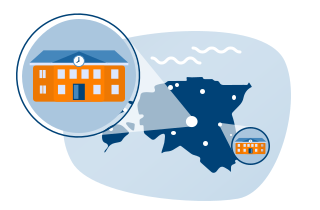
Find all general education schools in Estonia on the map.
Rescue Service: October 14 from 15:00 to 15:10 a public warning test will be carried out, sirens will sound. No danger. More info on olevalmis.ee
In Estonia, children have compulsory school attendance. The compulsory school attendance is in place up to the acquisition of basic education or up to the age of 18.
A child who turns seven years old before 1 October of the current year must start school. The local government will assign the school of place of residence to each child.The proximity of the school to the child’s place of residence, siblings attending the same school and, if possible, the parents’ wishes are taken into account.
The school of the place of residence may not have conditions that consider the child’s needs. The local government must then ensure that the child’s needs are met in another school. If that school is located in another local government, the local government of residence must arrange transport or reimburse the pupil’s travel costs.
To support the development of pupils, the school employs a special education teacher, speech therapist, psychologist, and social pedagogue. The main role of support specialists is to identify students’ special needs, support the learners, and advise teachers on how to adapt teaching to the child’s special needs. Teachers have the main responsibility for teaching pupils with special needs.
Find all general education schools in Estonia on the map.
Self-service
School map
Find all general education schools in Estonia on the map.
The support your child requires depends more on suitable and accessible learning arrangements than on their medical diagnosis or disability. If your child needs support at school, it can be arranged in a regular class or a special class, partly as individual teaching or in a smaller group..
In basic and upper secondary schools, the school must offer the pupil general support:
If general support is insufficient, enhanced or specific support may be needed. The need for additional support is assessed by the Rajaleidja external advisory team, together with specialists from other fields, eg specialist physicians, social workers, etc.
Enhanced support is available for pupils who require ongoing assistance from support specialists and an individualised curriculum. This support may include one-on-one or small group teaching, individual help during regular classroom instruction, or instruction in a special class, and it can encompass one subject, multiple subjects, or all subjects.
Special support is available for pupils who require learning arrangements, environments, methodologies, resources, and ongoing assistance tailored to their disabilities. This support may include integration with social and health services when appropriate. It enables pupils to participate in their learning through part-time individual or small group teaching, as well as continuous individual support in either a regular classroom or a specialised classroom.
Depending on your child’s state of health and individual development, they will have the opportunity to acquire basic education either following the standard national curriculum for basic schools or a simplified national curriculum for basic schools. The simplified curriculum is designed for pupils with intellectual disabilities:
The school must draw up an individual curriculum for pupils receiving coping skills and care education.
If, because of their health or individual development, a child is not yet ready to start school at age 7, the start of their compulsory education obligation can be postponed by one year. A recommendation from the preschool, or from an external counselling team, that has assessed the child's school readiness is required to postpone the start of the compulsory education obligation. To receive a recommendation from an external counselling team, you must submit an application to Rajaleidja – you can read more about how to do this in the step "Principles of inclusive education".
If your child’s medical condition prevents them from attending school every day, they can stay be enrolled in home tuition. Pupils in grades 1 to 9 who have a severe illness or disability and whose special needs cannot be accommodated at school may receive home tuition. Submit an application to the school for you child to attend home tuition. The application must be accompanied by a recommendation from an external advisory team. The application must also include the description of the pupil’s state of health. You can get this from your child’s family physician or attending physician.
The school staff council makes a decision on home tuition. Please note that the school may not enrol your child in home tuition without the parent’s consent!
If your child is hospitalised, they are entitled to teaching in a hospital. Hospital schooling is coordinated by two state schools: Konstantin Päts Open-Air School, Maarjamaa Education College, and Haapsalu Viigi School. The hospital teacher maintains a teaching journal to record dates, teaching content, assessments, and grades. If your child is hospitalised for more than ten days, the hospital teacher will work with the school your child normally attends.
After hospitalisation, the hospital teacher must provide your child’s school with a written summary of the hospital stay, including verbal assessments and grades given to the pupil. The hospital teacher can also provide suggestions on how to organise the teaching in the future.
An individual curriculum can be created for a pupil to select a suitable pace of learning and allow as much time as needed to achieve the learning outcomes. To this end, the time taken to complete a grade may be extended if necessary.
The school or individual curriculum may allow pupils with reduced mobility and sensory impairments 10 years to complete basic school. The standard study period in basic school is 11 years for pupils with moderate learning difficulties, and 12 years for pupils with severe and profound learning.
A school may offer supplementary studies to a pupil with special educational needs who has completed grade 9. Supplementary studies are intended for those who have finished basic school and need additional preparation and support in order to continue their studies smoothly and improve their social coping skills.
Supplementary studies last one academic year and take place in the same familiar environment for the pupil. If a pupil continues into supplementary studies, a transition plan is drawn up for them at the school, setting out the specific content of their studies and their timetable. You can get more detailed information about the options for supplementary studies from your child's teacher.
Ministry of Education and Research
The Education and Youth Board